
Meet Toryo Ito, the deputy head priest of Ryosoku-in temple who is fusing Zen philosophy with creative new ideas to nurture the growth and possibility inherent in all of us. Toryo-san started off by just implementing an easier booking system for his mediation classes, but now he’s running a variety of Zen programs that implement art and design into their concepts. Not limiting himself to the confines of the temple walls, he has taken his teaching and mission online and on the road. TITLE catches up with Toryo-san to talk about his mission and what his latest creative endeavor entails.


SA: Was becoming a monk a path that had been decided for you?
TI: No, not at all. My parents never pressured me to take over the temple. When I was around twenty-five years old I’d just begun training to become a monk, but I started to want to become a school teacher instead. So, I became a teacher at a cram school.
SA: Did you have any interest in Zen back then?
TI: Well, just on the surface level, yes, but I didn’t really think I wanted to get deep into it. I knew that Zen was great and how beneficial it is, but actually the more I worked at the cram school, the more I realized the beauty and strength of Zen and the endless possibilities it offers.I was inspired by the cram school, where they had these online booking systems that made it easy to book classes and made learning more accessible for people. Basically, I wanted to implement this sort of system to make the temple an accessible learning space for modern people. I realized that a temple is really meant to be a place where people can learn about life lessons and find answers. I wanted to make it my mission for our temple to become a place where people could do this.
SA: From online mediation and art programs at the temple to Zen-inspired camping cars… Who is your target audience when you are creating these activities?
TI: Well, we don’t really target a specific group, but we offer programs that are more art and design orientated because we want to engage people who are already living a conscious life but are looking for ways to enhance it a little bit more, or people who are looking for a missing piece of some sort… We want to bring out the potential in people. I feel that our programs aren’t for people who are trying to get out of money trouble or looking for some kind of life makeover.

SA: When you are creating these projects, what do you keep in mind to make sure the meaning of Zen isn’t misrepresented or lost?
TI: This is something really important to me. I mentioned it briefly before that these programs are all about bringing out the potential in people. That was a very condensed way to explain it, but it all goes back to the name of this temple.The kanji in Ryosoku-in mean “wisdom” and “compassion”. I always go back to these words and make sure our programs nurture these traits in people. Whenever I doubt if the program is right for the temple, I go back to the temple’s name.
SA: In a traditional city like Kyoto, what are people’s reactions towards these programs?
TI: I admit it’s hard not to care at all what people think… But honestly, before I even start a program, I always know someone will have something to say. So, I’m never surprised if someone says something negative about what I’m doing. The thing is, I understand my position and I understand where I stand. On one hand, I know it’s really important to stick to tradition and do everything the “traditional way”. But I also know that I’m not that person. That’s why I appreciate and respect those who do value following tradition as it always has been. I am allowed to do something different precisely because there are still people out there who are protecting tradition.
SA: What is the connection between art and Zen?
TI: This also relates back to the word “possibility”. There is a saying in Buddhism that Zen doesn’t rely on words or a scripture. When trying to communicate with language, you can always reach a wall, whether it takes the form of not being able to speak the same tongue or simply not knowing enough to express yourself. With art, it’s open to interpretation, there are many possibilities. Just like how Zen doesn’t rely on words or scriptures, art doesn’t rely on information or text. People can express or view that art in their own way. Information is not just from a book, it’s something you feel in your body. The big pull with art is that you’re able to do that, feel everything in your body just like with Zen.
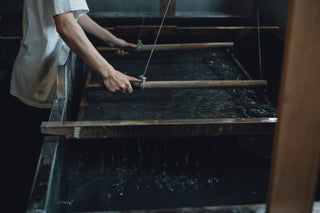
ハタノワタルの和紙
ハタノワタルは、和紙の産地である京都府綾部市で紙漉を行っている。ハタノは、美術大学で油画を専攻していたとき、絵画の支持体として、和紙に出会う。ハタノに和紙の魅力を聞いた時、一番に出てきた言葉は、その美しさではなく、その丈夫さであった。
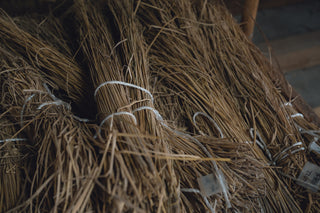
Ikuya Sagara's Thatch works
When it comes to Kobe, the impression is that of a port city. However, if you turn your gaze towards the mountains, in the northern area of Kobe...